
The Short Answer: The primary difference between a stable Battery Energy Storage System (BESS) project and a fragile one is the continuous alignment of its system architecture, automated control logic, and proactive operational discipline once deployed in the real world.
Key Takeaways
- Passing initial commissioning is just the beginning; many systems fail to meet capacity during Site Acceptance Testing (SAT).
- A system’s stability depends on its ability to absorb unpredictable external variables without drifting into costly reactivity.
- Long-term success is rooted in the continuous alignment of system architecture, control logic, and operational discipline.
- Maximum efficiency and safety require sustained attention and proactive oversight across the asset’s entire lifespan.
Battery energy storage projects often look successful on paper. Specifications are met, commissioning is completed, performance tests are passed, and the asset finally goes live. At that point, it’s easy to assume the hard part is over. But this is when the critical part begins.
In fact, the cracks often show before the system even hits the grid.
According to recent industry data from ACCURE, only 83% of projects met or exceeded nameplate capacity during Site Acceptance Testing (SAT). This underscores the importance of using best practices and independent oversight earlier in the design, procurement, and commissioning processes.
If a system is already struggling to hit baseline capacity during controlled testing, those challenges will only compound once it faces the physical realities of the grid.
What Happens When A BESS Faces Real-World Operations?
After a BESS goes live, the system is exposed to external conditions that no commissioning test can fully replicate. None of these events is unusual or unexpected. They are simply part of operating in reality, versus the test lab. A few examples include:
- Changing load profiles
- Fluctuating temperatures
- Lagging communication signals
- Necessary software updates
The crucial question is how well your specific system can handle and absorb normal events day after day. As these variables start to pile up, some storage projects stay steady and behave exactly as predicted. But others slowly become more reactive. Tiny problems stack up, and more frequent manual adjustments are needed. The system might still function, but it’s less stable than it was on day one.
What Are The Core Pillars Of Long-Term BESS Stability?
When a system starts to drift like this, it’s rarely tied to a single component. Instead, the problem is typically rooted in project initiation and design. What separates systems largely comes down to three operational layers:
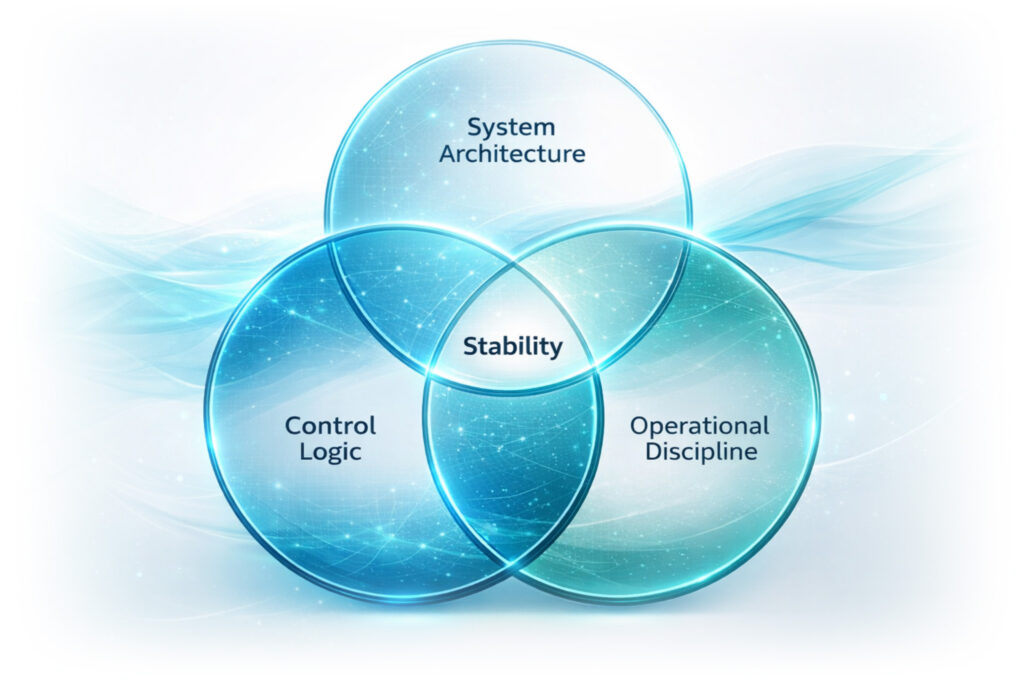
System Architecture
Architecture plays a central role, and decisions about module arrangement, thermal pathways, protection schemes, and monitoring visibility define how energy, heat, and information move through the system. These architectural components influence whether stress is distributed or concentrated.
Control Logic
An extremely close second in critical importance is control logic. Once live, a system is constantly making decisions. It determines how to respond to deviations, and when to derate, isolate, and escalate. It’s possible to have two systems built with similar hardware that behave very differently. This depends on the structure of the architecture and control logic.
Operational Discipline
Along with architecture and control logic, monitoring and operational discipline complete the BESS implementation and operation cycle. Clear visibility, defined response procedures, and measured software updates allow small deviations to be addressed and modified in the early stages of development. Without this discipline, even well-designed systems can drift.
Real-World Scenario
Consider two hypothetical 50MW facilities built with the exact same Tier-1 battery cells.
Facility A relies on basic, out-of-the-box control logic and minimal operational oversight. Within a year, micro-deviations in cell temperatures lead to frequent derating.
Facility B customized its control logic during initiation to aggressively distribute thermal stress and employed rigorous monitoring.
Despite identical hardware, Facility B maintained 99.8% uptime, while Facility A drifted into reactive, costly maintenance cycles.
How Do You Ensure BESS Coordination Across The Asset Lifecycle?
When architecture, control logic, and operational discipline reinforce each other, stability is the result. The system operates within predictable boundaries, even as unexpected events or conditions arise. When these three layers are misaligned, variability is amplified instead of absorbed, and the system is not at max operational efficiency.
In complex energy systems, safety and long-term performance are not assigned at commissioning, but emerge from coordination across the lifecycle of the asset. What ultimately separates stable BESS projects from fragile projects is not a single specification or milestone. It’s the quality of integration, the clarity of decision-making, and the consistency of operational oversight. Long-term success is demonstrated gradually through disciplined design and sustained attention to how the system behaves in the real world.
Frequently Asked Questions (FAQ)
Why do BESS projects drift or fail after commissioning?
BESS projects typically drift because they struggle to absorb unpredictable real-world variables, such as temperature fluctuations and changing load profiles. This instability is usually rooted in misaligned system architecture, generic control logic, or a lack of proactive operational monitoring.
What is a BESS Site Acceptance Test (SAT)?
A Site Acceptance Test is a formal validation process conducted at the installation site. It verifies that the BESS performs according to its design specifications within its actual, real-world operational environment before it goes fully live on the grid.
BESS Stability Checklist: Is Your Asset At Risk Of Drift?
Before closing out your next commissioning phase, ask your integration and operations teams these three simple questions:
- Is the system architecture structured to distribute operational stress, not concentrate it?
- Does the control strategy respond proportionally and predictably when conditions deviate from plan?
- Are monitoring and update processes disciplined enough to catch small deviations before they compound?